
An interview with 2025 Artist Resident Pablo Lazala Ruiz ahead of his group show opening on October 30, 2026 at Chicago Artists Coalition. This spotlight series aims to serve as an intimate introduction to our residents and their work through a Q&A-style interview. Interview originally conducted on August 11, 2026 by Dana Randall, Communications and Alumni Relations Manager at Chicago Artists Coalition.
Q: Do you have any common themes running through your most recent works in progress?
A: Yes, many threads run across the projects. Questions of new modes of self-organization, power structures, and the materialities of ideologies have been central for me. But I don’t see them as concepts alone. I’m interested in how they run through recent work as actions (verbs): built environments act on our bodies and shape how we move through the world, so actions and movements matter more than the static idea.
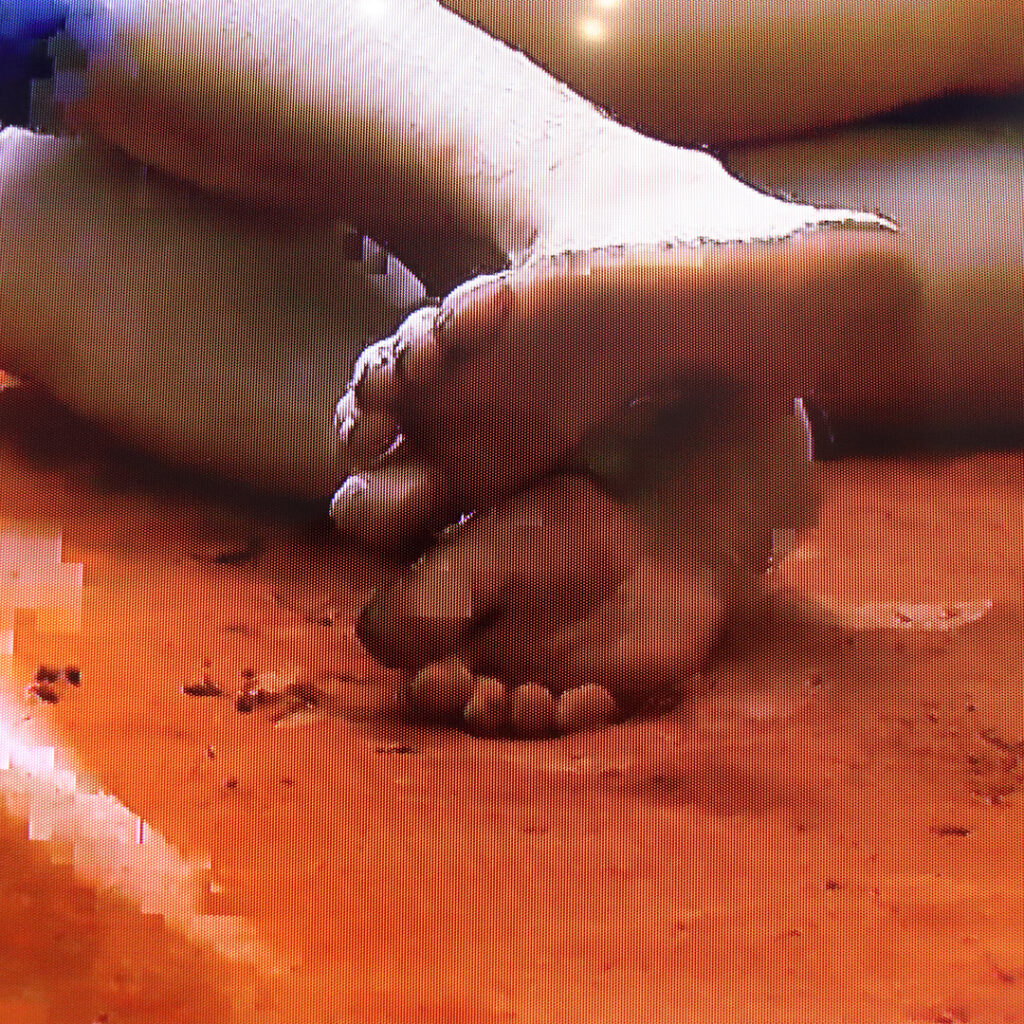
I’ve also been working with burial and ruminating on it a lot: funerary rites, the resting places of the dead, and the space we hold for those who cannot be found, and so cannot be buried. Burial opens onto land ownership and the political, spiritual, and formal dimensions of how we bury, and the place we create for the beyond and for rest.
Q: How has your work evolved since being in the CAC residency?
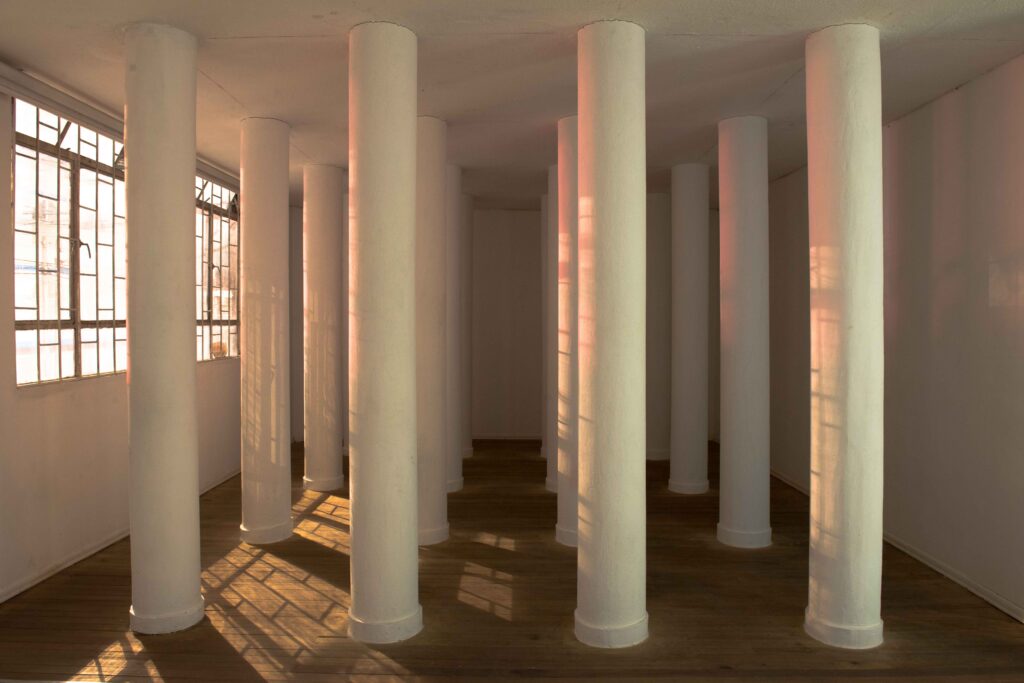
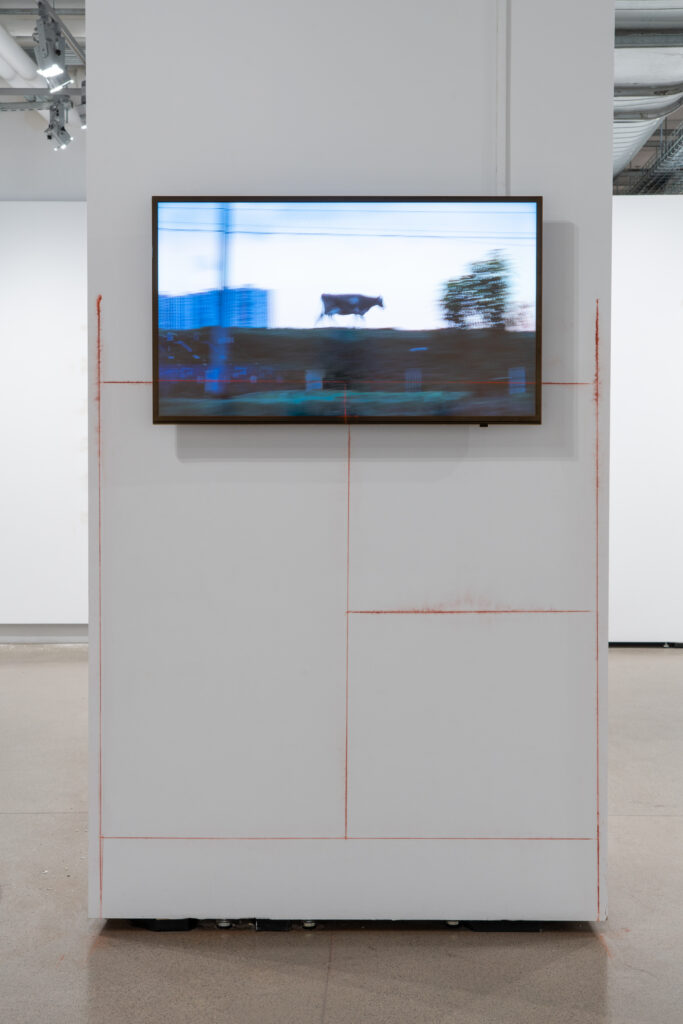
A: Since being in the residency, I’ve been able to observe more clearly the ways I worked in Bogotá. There, the city informed my practice more than the studio. Most of the research and material processes happened outside, in public space, where authority, surveillance, infrastructure, and financial and political systems intersect and remain in tension, in a city under constant remodeling and repair. I probed the ideas of progress embedded in the city, infrastructure, and architecture, and how the built environment tells us where power is located. That’s why I was drawn to support structures: scaffolds, ladders, bridges, sidewalks, rugs. Less the text than the paratext, everything that frames and holds it, as a way to understand the text, or what is visible and at the center, in all its complexity, without looking away from anything.
What was being addressed in the field of the arts as site-specific was simply my way of working and moving: directly with sites, and with the people, structures, and rituals that hold and create them. In Chicago, as an immigrant, I find those conversations with sites mediated by laws, liabilities, costs, and surveillance in a way I’ve never experienced. That has made me think a lot about how to build bridges across so many systems of division while still touching the invisible qualities of a place.
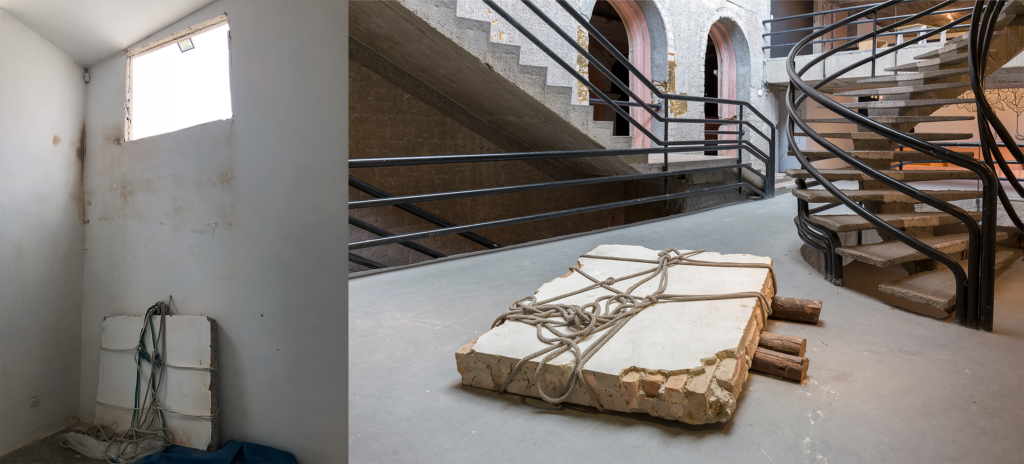
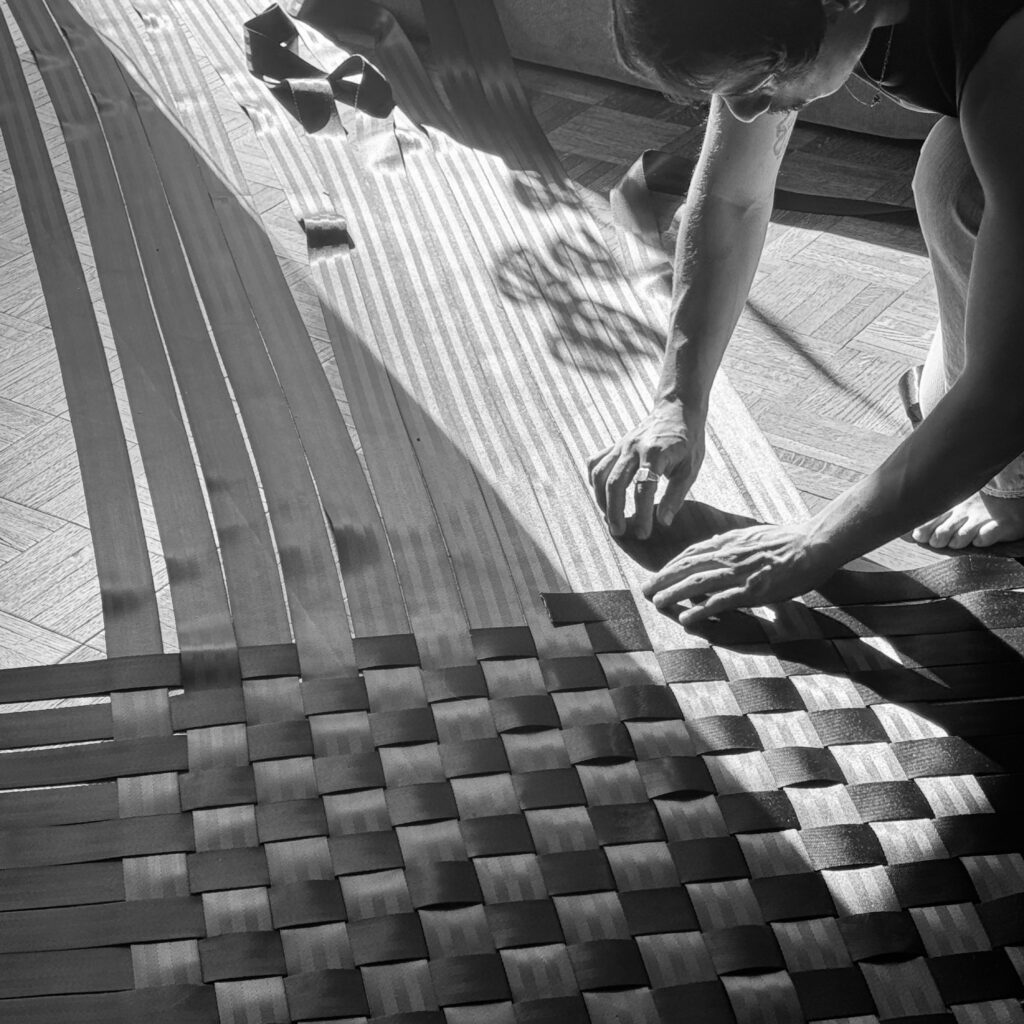
During the residency, I’ve focused (or had to focus) on objects again. After many years of site-specific installation in Colombia, I’m finding ways to also collaborate with the site and respond to it by bringing it into a more intimate setting, like the studio. These years of residencies, alternative programs, shows, teaching, and work as a preparator, exhibition designer, and builder have expanded the research, language, and questions around my work. They’ve opened space for new techniques like weaving, for the expertise of object makers here, and for learning from artists, thinkers, and organizations who resist in many ways and create links and platforms in a place as surveilled and regulated as this one.
Q: What are some of your biggest artistic influences? Where do you find inspiration?
A: What inspires me most are the spaces where people come together to share knowledge and discuss global issues outside traditional academic and institutional settings and formats, and to practice other ways of learning, teaching, and imagining possible futures, like lugar a dudas in Cali, SOMA in Mexico City, COOPIA in Bogotá and Mexico City, and Contranarrativas, among others. They nourish me, and I take what I find there back into my practice, and honestly, into being alive.
In Cali, Lugar a Dudas has worked since 2005, and its way of operating has been a school in itself for generations of local artists: programs built around a library of contemporary art and a pioneering commitment to letting young artists exhibit under dignified working conditions. I recently took part in SOMA Summer in Mexico City, a program that weaves together theoretical inquiry, artistic practice, and the discussion of contemporary global issues through seminars, group critiques, and studio visits grounded in mutual listening and horizontal exchange.
COOPIA, with whom I’ve had the chance to take part in workshops and laboratories, is a cooperative experiment organized by people across Bogotá and Mexico City, committed to learning by inhabiting a territory, toward its socio-environmental transformation and toward autonomous, anti-capitalist, anti-patriarchal, and anti-colonial ways of being and doing. Contranarrativas is a horizontal, collaborative project of knowledge production, cultural management, and free communication: public seminars, a creative lab, an independent press, and a South–South dialogue committed to the anticolonial and peripheral narratives, knowledges, and aesthetics of the Global South.
I believe it’s important to name them.
Q: Tell me about your favorite mediums. What about them speaks to you?
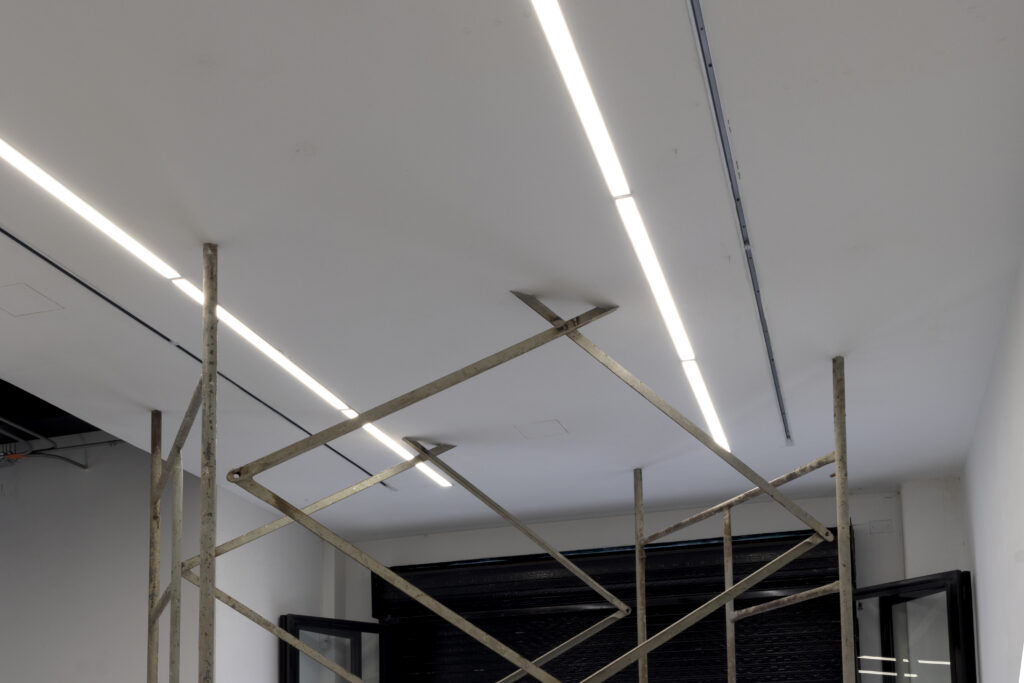
A: I wouldn’t say I have a favorite medium. Each project brings its own challenge, intention, or curiosity, and that calls for a different dialogue and exploration across mediums. And framing the medium has always been a whole question in itself. One could frame the work in the realm of sculpture, but I’m really interested in working with the languages of installation because it shifts the question from what the object is to what is created and experienced through the relationships among objects, spectators, space, and context, and it expands, or even breaks, the framing of a single medium.
Q: Do you have a favorite time of day to create? How does the time you find or choose to make influence your practice?
A: Not by choice, but I work mostly at night. During the day, I have always had jobs, classes, and work hours, and at night I’m supposedly free, so that became my time to make art. It is now a habit. Even for this show, I’ve been installing after work at night. But now I really enjoy it. I like the night.
Q: In keeping with our values, one thing we want to do is cultivate a community of knowledge-sharing. What is something you would encourage other artists to learn about? What is something that made a difference in your career?
A: Be in conversation with other people: artists, creatives, scholars, people from other disciplines, professionals and non-professionals. That’s something I really believe in and stand for. Many practices can isolate people, or we can isolate ourselves in the studio or in our own worlds, and that time matters too.
But you need the movement and nourishment of different perspectives and voices that challenge you and your work. That means letting go of some control and allowing new experiences and new people to move through you, sharing your work with them and staying in conversation. For me, that’s what has made the biggest difference. Everything I’ve been able to do came from putting myself in that movement and circulation, including the uncomfortable places.
Q: Do you have a personal philosophy relating to your practice or your life?
A: Intuition is very important to me. There are impulses I think we need to let ourselves hear and listen to. Of course, at the end of the day, the exercise is about regulating them, but for me, everything starts there: in the gut, in the center. It’s like planting a seed. So my philosophy is to listen to that gut, whether for work, decisions, or professional habits. It’s about trusting the body and training it, learning to feel with the body but also to think with it. Thinking with the body matters a lot to me.
Q: Is there anything else you’d like to share?
A: My work is in a moment of big shift, of reintegration. After a long time of research and conversations, I’m returning to material, physical, spatial work. I gave myself that time to share with other voices and take in a lot, and now I’m very excited to bring it into the work. Right now it’s more about praxis than concepts and ideas alone, and I like that dance because it’s never linear: it jumps, shifts, and moves in circles. It feels like a hinge moment, like a lot of water is coming, and coming with strength.
Website: pablolazalaruiz.com
Instagram: @pablolazalaruiz
You can view Pablo’s work at his group show opening on Friday, October 30, 2026 from 5-8pm at Chicago Artists Coalition alongside Mauricio López F. and Gabriel Moreno, curated by Serena JV Elston.